
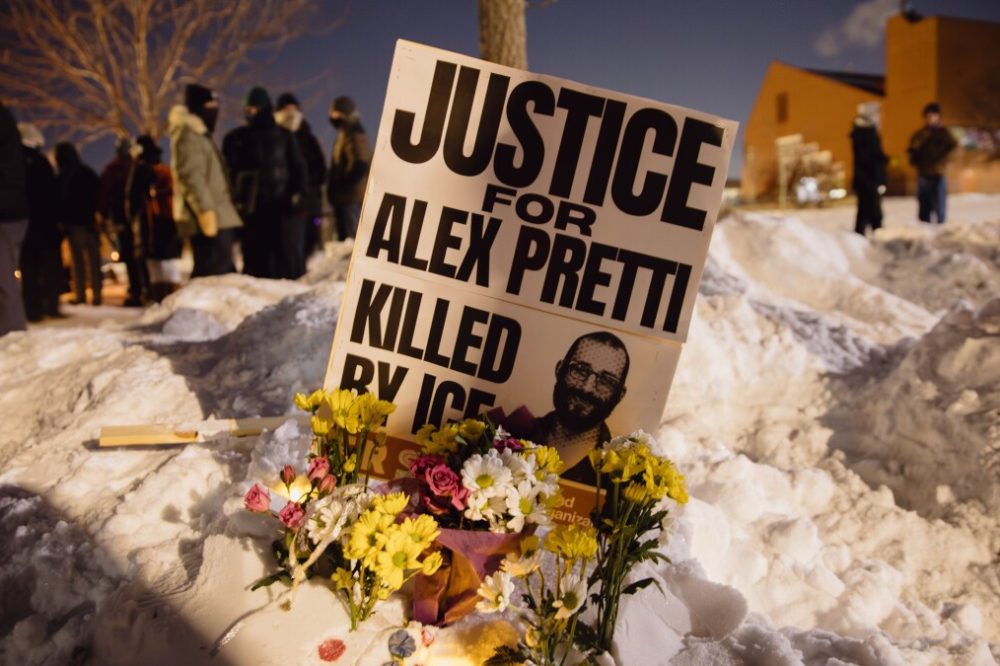
Minneapolis, The fatal shooting of Alex Pretti, a 37 year old intensive care nurse and United States citizen, has become a focal point in a growing national debate over federal law enforcement accountability, transparency, and the treatment of civilians during protest related operations.
What initially appeared to be a straightforward use of force explanation offered by federal authorities has, over time, become increasingly difficult to reconcile with publicly available video footage, witness accounts, and subsequent clarifications from local officials.
The case now stands as a test of institutional credibility, raising questions not only about what happened on a Minneapolis street, but also about how truth is communicated when state power is involved.
The First Official Version of Events
In the immediate aftermath of the shooting, senior figures from the Department of Homeland Security described Alex Pretti as an imminent threat. Statements released within hours alleged that he had attacked officers and brandished a firearm during an enforcement operation.
In legal and public terms, those claims carried substantial weight. Brandishing a weapon implies visible intent to threaten, a factor often cited to justify the use of lethal force.
Yet as scrutiny intensified, the certainty of that initial narrative began to erode.
A Shift That Did Not Go Unnoticed
During a televised interview the following day, the language used by senior officials changed. The word attack was no longer used. Instead, viewers heard a softer phrase, laying hands on law enforcement.
For legal analysts and civil rights advocates, the shift was significant. In cases involving deadly force, the difference between an attack and physical contact can determine whether an action is deemed lawful or excessive.
What the Videos Actually Show
Within hours of the shooting, bystander videos began circulating online. Taken together, they provide a partial but revealing timeline of the encounter.
Key Details Visible in the Footage
- Alex Pretti is clearly seen holding a mobile phone
- No firearm is visible in his hands at any point
- One of his hands appears empty throughout the interaction
- He moves toward officers after a woman is pushed to the ground
- Federal agents quickly shove and restrain him
- A firearm appears only after he is already pinned down
Crucially, none of the footage shows Pretti displaying, pointing, or threatening officers with a weapon.
This absence has become central to the public scepticism surrounding early federal statements.
Local Law Enforcement Response
Minneapolis Police Chief Brian O’Hara later confirmed that he had seen no evidence supporting claims that Pretti brandished a firearm. His remarks further complicated the federal account and reinforced calls for an independent review.
Escalating Claims Without Corroboration
As the story gained national attention, rhetoric from some senior figures intensified. Pretti was described using terms such as assassin, with suggestions that he intended to carry out a mass attack on officers.
Those claims travelled quickly across cable news and social media platforms.
What Was Absent From the Narrative
Despite the severity of the accusations, no supporting evidence was presented publicly. By the following day, the same claims were no longer repeated in interviews.
When questioned, officials cited ongoing investigations.
The gap between rhetoric and evidence has become one of the most troubling aspects of the case.
Understanding Who Alex Pretti Was
Accounts from family members, colleagues, and friends present a markedly different picture from the one initially offered by federal authorities.
Pretti worked as an ICU nurse at a Veterans Affairs hospital, caring for critically ill patients. He had no criminal record and no known history of violent behaviour.
Why He Was at the Protest
According to those close to him, Pretti had attended several demonstrations following the earlier killing of another Minneapolis resident during an immigration related operation. He was known to document police interactions, believing that recording public events served the broader public interest.
His family has stated that portraying him as a threat not only misrepresents his actions, but compounds their grief.
Gun Ownership and Minnesota Law
The presence of a firearm played a central role in the official justification for the shooting. However, Minneapolis police confirmed that Pretti legally possessed a permit to carry a concealed weapon.
What the Law Permits
Minnesota law does not prohibit licensed individuals from carrying a concealed firearm at a peaceful protest.
Several gun rights organisations publicly clarified that claims suggesting otherwise were inaccurate.
Key Legal Distinctions
- Lawful possession does not imply intent to harm
- Carrying a concealed weapon alone is not a crime
- Brandishing requires visible threatening conduct
These distinctions are critical when assessing the legality of using deadly force.
Constitutional Issues Raised by the Case
Legal scholars note that the incident raises profound constitutional questions. Pretti appeared to be exercising his First Amendment right to record law enforcement activity and his Second Amendment right to lawful gun ownership.
If both rights were being exercised lawfully, the threshold required to justify lethal force becomes exceptionally high.
Potential Civil Liability
Civil rights attorneys suggest that any wrongful death case would focus on whether officers reasonably believed there was an immediate threat to life.
Video evidence that contradicts such a belief could play a decisive role.
The Missing Phone Footage
One unresolved issue continues to fuel public concern. Witnesses say Pretti was recording events on his phone when officers first confronted him.
A judge has ordered the preservation of all evidence, including any footage recorded by Pretti himself.
That footage has not yet been released.
Why This Absence Matters
In numerous high profile cases over the past decade, phone and body camera footage has been instrumental in establishing accountability.
The continued absence of this material has deepened public distrust.
Bipartisan Pressure for Transparency
Calls for an independent investigation have crossed party lines. Lawmakers from both sides of the political spectrum have urged federal agencies to allow external review.
Some officers involved in the operation have reportedly been reassigned while inquiries continue.
The Role of Independent Journalism
Much of the public understanding of the case has come from sustained reporting by independent media. Coverage by established outlets, including detailed live reporting by international news organisations, has highlighted discrepancies between official claims and video evidence.
This article builds on that reporting through independent analysis and publicly available material.
A Broader Test of Trust
The killing of Alex Pretti has grown into more than a single tragic incident. It has become a measure of how institutions respond when their narratives are challenged by visible evidence.
In recent years, video recordings have repeatedly forced revisions of official accounts.
This case appears to be following the same trajectory.
Why the Outcome Matters
For audiences in the United States and the United Kingdom, the implications extend beyond Minneapolis.
The case touches on fundamental democratic principles, including transparency, proportional use of force, and the right of citizens to hold power to account.
What Happens Next
Until all evidence is released and examined independently, serious questions will remain.
For the Pretti family, the issue is one of truth and dignity. For the public, it is about whether accountability applies equally, even when federal authority is involved.
The footage has already reshaped the debate. Whether it leads to justice now depends on the choices made by institutions entrusted with public power.