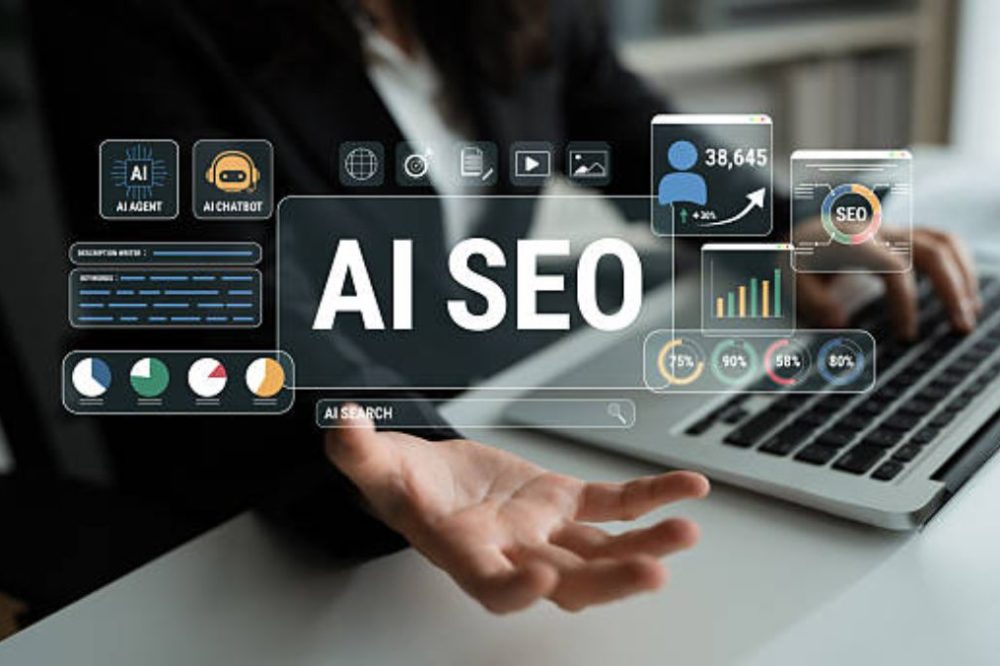
You are not imagining it and you are not the only one. Your organic traffic has been steadily declining over the past year but your rankings stay the same. AI SEO 2026 is not some buzz word that can be thrown about at marketing conferences. It’s a physical revolution in the way people obtain information and it’s rewriting the laws that regulated search for 20 years.
The problem is AI Overviews – the boxes with AI generated summaries that now sit above the ordinary search results – and a wave of AI native search tools like ChatGTP, Perplexity and Gemini that are pulling discovery away from the normal ten blue links totally. This video will cover what AI Overviews are, how they are revolutionising SEO, and what businesses need to do differently to get seen.
What is an AI Summariser?
These summaries, known as AI Overviews, are generated by Google’s AI and appear at the top of search results for many searches, pulling in material from a number of sources and condensing it into one response that appears before the user has even clicked on a link. People are increasingly finding their answer right there on the results page, not browsing a list of rated pages.
Adoptions are on the rise. You’ll begin to see AI Overviews appearing for more and more queries – particularly for informational searches such as “what is,” “how to,” and “best.” Since their first publication, the percentage of such queries has climbed considerably. Research from renowned SEO research organisations has demonstrated that organic click-through rates for top-ranked sites fall off a cliff for enquiries that produce an AI Overview, since a lot of consumers obtain a comprehensive answer without ever needing to visit a website.
This is a game changer for SEO.
Traditional SEO was based on a simple premise: get as high a ranking as possible and the visitors will come. That maths doesn’t add up any more. The better question in 2026 is “where am I at? “Is that me the source the AI is quoting?”
This has, in effect, split search visibility into two related but different disciplines:
- There’s still room for classic SEO, those ranked, clickable results, and it’s important for transactional searches when people are actively exploring options or ready to buy.
- Generative Engine Optimisation (GEO) (also known as answer engine optimisation (AEO)) has one goal: for your material to be referenced, mentioned or suggested in AI-Generated Answers, chatbot responses and AI Overviews.
Both professions share the concept that clear, authoratative and well structured information is crucial for both, but they measure success differently. SEO Metrics: Clicks and Rankings. GEO tracks citations, mentions and share of voice in AI generated responses. But for most companies today the answer is not either/or, but both/and.
The truth about how AI summaries pick their sources
Many people assume AI Overviews work via a separate submission or paid placement process. No, they do not. Google’s AI Overviews are largely drawn from pages that already rank well organically – so solid old-fashioned SEO strategies are still a prerequisite, not a replacement, for AI visibility. Research indicates that AI Overviews tend to cite the first organic results, meaning if your website is not already indexed and ranked very high, it is unlikely to be quoted at all.
But there are many more characteristics that will influence whether an AI system will cite a page, beyond just the basic rankings:
- Extractability – content is written in short, self-contained units that can answer a query right there, not buried in long, rambling paragraphs
- Structured data and schema markup – Machine-readable formatting that helps AI systems understand precisely what a page is about
- E-E-A-T signals – Experience, expertise, authoritativeness and trustworthiness, which search engines and AI systems are increasingly using to evaluate which sources deserve to be cited
- Entity Authority – Being known across the internet as a trusted authority on a subject, not just ranking for a single term.
- Fresh and accurate – Up-to-date, factually accurate content that AI systems can reference with confidence.
The metrics that count now
If you’re a business owner or marketing team looking at an SEO firm or SEO software platform in 2026, it’s time to go beyond the old scorecard of ranks and organic sessions. The metrics that count are:
- Citation Frequency – How often your brand or content is quoted in AI Overviews and chatbot answers
- Branded Search Volume – People will search your brand even if they don’t click your result if it’s mentioned in an AI answer.
- Zero-click visibility – even if an AI answer doesn’t result in a traditional pageview, having your brand name in an AI answer nevertheless boosts brand awareness
- Conversion quality of AI-referred traffic – Visitors who click through from an AI Overview are generally further along their inquiry, and will often convert at significantly higher rates than regular organic traffic.
Actionable strategies to optimise for AI search in 2026
You don’t need to throw away everything you know about SEO to adapt your content strategy to this new environment – you need to build new practices on top of a good foundation:
- Now answer the question. Each section should begin with an answer to the question. Post-response explanation or elaboration may be provided. AI systems such as content that does not need to rely on it to assemble an answer from different conditions
- Use short sections and clear headings. Use descriptive headers to break up data into scannable bits – this helps search engines and AI systems pull just the part they need.
- Add structured data markup. AI systems don’t find it as easy to understand the structure and purpose of your material when it’s plain text. Schema markup (FAQ schema, HowTo schema, Article schema) helps.
- Acquire genuine expertise in topics. Authority is based on depth and consistency, not volume, therefore a single good resource on a subject will generally outrank a bunch of scattered shallow posts.
- FAQ Frequently Asked Questions. Here are some of the most common questions we hear about using our API. If you do not find your question answered here, please do not hesitate to contact us.
- Can I use your API commercially? Alright.There is no charge to access the API, however we do have rate limits in place to ensure equitable usage between all users.
- What are the API rate limits? Our API is rate limited to 100 requests per minute per IP address. If you require higher rate limitations please contact us to discuss your requirements.
- How to authenticate API requests? Use an API key to authenticate your API queries. You can create an API key in your account settings. Never share your API key with anyone. Do not disclose.
- What type of data may the API return? Our API allows you access to rich data, like user profiles, posts, comments, and much more. The data you can access is based on the permissions of your API key.
- Is there a sandbox to play around? Yes, we offer a sandbox environment to test your API integration. You can get into the sandbox environment using your API key by setting the sandbox parameter to true. Supported programing languages are: Our API is language agnostic.
- How do I report a bug or a feature request? If you find a bug or have a feature request please open a report in our help site. Your feedback is important to us and we will try our best to resolve your problems.
- I have a problem with the API, can I get some help? Yes, we do support our API users. You can contact our support team via our support portal or via email directly to us. And we’re here to help!
- Think Beyond Google. It’s not just about being on one search engine anymore, it’s about being referenced across several AI platforms. AI search tools like Perplexity, Gemini and ChatGPT are becoming the preferred starting point for research.
- Quality not quantity. Search engines have also better at penalising thin, mass-produced items. There will always be fewer, more researched and expert reviewed items that will be superior to a high volume of generic AI-written entries.
Is Old School SEO still worth the money?
Yes, and this is one of the most misunderstood aspects of the transition. Classic SEO is not dead, and this is what GEO is built on. AI Overviews are so dependent on the top-ranking sites that organisations who dump core SEO practices merely to chase AI citations alone are cutting the same signal that gives them citations in the first place.
Traditional organic clicks are still very much alive for transactional and commercial-intent queries – where users are actively investigating things, asking for quotes or preparing to buy – as AI Overviews are considerably less dominating on these types of queries as compared to purely informational ones. And that’s exactly why it still pays to hire a skilled seo agency or invest in solid seo solutions, especially for organisations in competitive commercial categories such as ecommerce, legal services, insurance and healthcare.
Takeaway for your content marketing strategy:
The lesson for any organisation developing a content marketing strategy in 2026: Stop judging success by ‘catching a click’. Even if the page is not clicked on, a page that is named in an AI Overview helps to create brand trust and awareness with a user who may then go on to search for you directly. Citations should be ranked. Structured data should be a first-class citizen, not an afterthought. Each page you publish should be a solitary, obvious, extractable answer to the problem it solves.
Summary
AI overviews haven’t killed SEO, they’ve separated it into two related disciplines that organisations now have to undertake together. According to traditional SEO, your pages still need to be indexed, trusted and scored well enough to be viewed as a reputable source. Generative engine optimisation: Do AI systems truly want to cite you when you are in the running. No discipline works quite so well in isolation anymore.
The businesses that will thrive in AI SEO 2026 are those that embrace this as an evolution, not a threat – doubling down on real expertise, clear structure and accurate, well-cited content, while tracking the new metrics of citation frequency and branded search lift, on top of the traditional rankings report. Search will not die. Now it’s beginning to answer enquiries directly. The companies that modify their content to be the answer, not just a link under the answer, will be the ones to win.
Frequently Asked Questions
Q1. What is AI SEO and how does it vary from traditional SEO?
AI SEO is not about ranking in a traditional list of links, rather it’s about creating content that has a higher likelihood of being mentioned or referenced in AI generated search results, chatbots and summary tools. It’s based on traditional SEO – quality, authority and relevance still essential – but puts an emphasis on extractability, structured data and citation-worthiness for AI systems.
Q2. Is AI the death of SEO?
No, AI Overviews are changing the way visibility is measured, not decreasing the importance of ranking well. AI Overviews are largely gathered from top organic websites thus normal SEO still works for exposure in AI and transactional queries can still earn a lot of organic clicks.
Q3. How do I get information into Google’s AI Overviews?
There is no separate submission process — Google’s AI Overviews will pull from sources it already trusts, using existing rankings, structured data and authority signals. The best way to get cited is to have strong E-E-A-T signals, authoritative information, clear and well-structured material, and correct schema markup.
Q4. What is generative engine optimisation (GEO)?
Generative engine optimisation is the process of boosting content and brand visibility in order to get AI-powered search engines such as Amazon’s Titan, Perplexity and Gemini cite, promote or reference your content when responding to relevant user requests. It is becoming understood as a discipline that enhances not substitutes for traditional SEO.
Q5. Does zero-click search hurt my business?
Depends on the sort of question. While there’s no denying that zero-click behaviour reduces direct traffic for simply informational questions, it’s still the case that being mentioned by name in an AI answer helps to develop brand awareness and can lead to an increase in branded search volume afterwards. Clicks and conversions are still very much alive and well for searches with transactional and commercial intent thus investing in SEO and content marketing is worth it.

Enjoyed this article?
If this guide helped you, consider supporting Rough Diary. Your support helps us continue creating practical, informative, and useful AI and technology content.