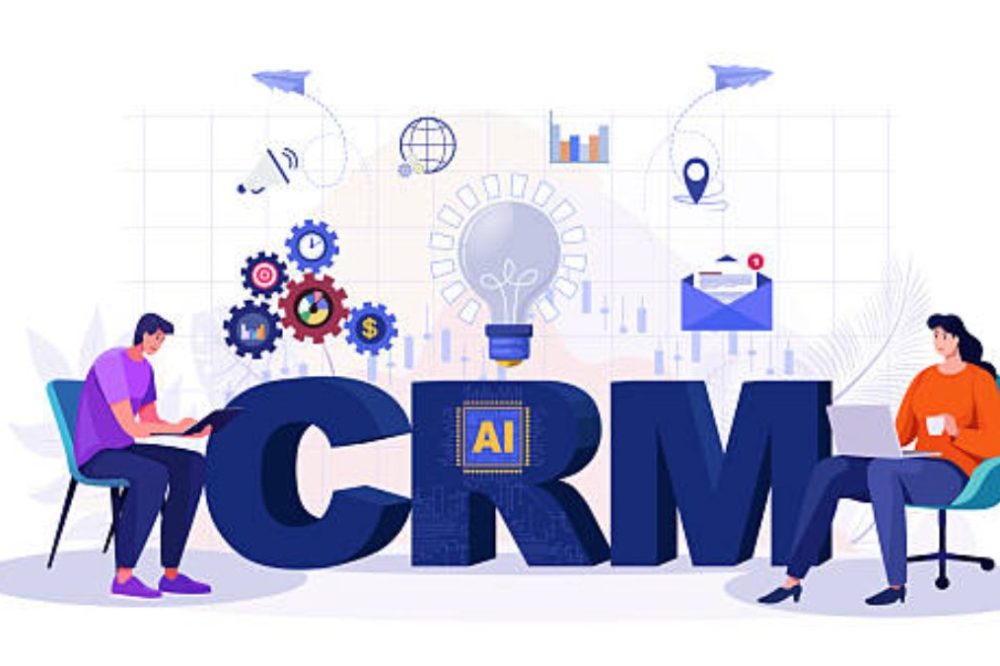
Sales people spend a lot of their week not selling. Salesforce industry study states that about 60% of a rep’s time is spent on admin work, data entry, and other non-selling activities. That’s precisely the gap AI CRM software is designed to fill – automatically logging emails and meetings, scoring leads by likelihood to close, summarizing calls, projecting revenue, and presenting the next best step so salespeople spend their time on interactions instead of data entry.
The category moved swiftly. The first AI CRM capabilities were primarily reactive: a chatbot here, a forecast there. By 2026, the main platforms have moved to AI bots that function with real autonomy: qualifying leads, crafting outreach, indicating transaction danger without a rep needing to ask. This guide decodes the top AI-powered CRM software for sales teams, what they actually do effectively, and how to choose the right one according on your team size and sales motion.
What Makes a CRM Truly “AI-Powered” (and Not Just AI-Washed)
“A lot of CRMs are putting AI on the feature list and not changing how the reps work.” The few unique capabilities that are really worth paying for in platforms:
- Predictive lead scoring – evaluating prospects by actual potential to convert based on past win/loss statistics rather than simple rule-based scoring
- Automated activity capture – emails, calls and meetings logged to the right record automatically, no manual entry required
- Deal risk and forecasting – identifying which deals are stuck and estimating revenue outcomes based on pipeline analysis and rep performance
- Generative help – composing emails, summarising long threads and creating call recaps in the flow of work
- Autonomous agents – this is AI that can source and qualify leads or do first-touch outreach on its own, rather than just proposing what a person should do.
It’s all very dependent on the data being accurate. No matter how clever the underlying model, any AI CRM based on a foundation of untidy, duplicate, or stale contact records will generate incorrect forecasts – a point to keep in mind before evaluating any specific platform.
1. HubSpot Smart CRM – The Best Overall AI CRM
HubSpot routinely rates as the finest all-around AI CRM software, and for good reason. HubSpot unifies marketing, sales, and service, so everyone on the funnel has the same context, and its AI is grounded directly in real CRM data, not as a bolted-on overlay. Its Breeze AI suite features a free helper for writing emails, summarizing records and prepping reps for calls, with more complex AI agents on premium levels. Prices start at roughly $17 per user per month on an annual basis, and there is a free plan (which doesn’t come with any AI features, though).
Best for: B2B and SaaS organizations who want one shared data layer to power sales, marketing and service AI.
2. Salesforce (Einstein & Agentforce) – Best for Enterprise Level Sales Teams
Salesforce is still the enterprise powerhouse, designed for sophisticated sales processes, worldwide teams, and significant customization through its AppExchange marketplace. Its Einstein AI solution features lead scoring, automated activity capture, deal risk analytics and revenue forecasts, while Agentforce brings autonomous AI agents that qualify leads and nurture prospects with little human involvement. The forecasting accuracy is best in class, but the platform’s strength comes with enterprise-level pricing and implementation complexity.
Best for: Large sales organizations that close high-value deals and need the most powerful forecasting and customisation, where cost is less of a constraint.
3. Zoho CRM (Zia) – Best Value for Expanding Teams
Zoho CRM’s pricing is aggressive and it has a really good set of AI capabilities called Zia that includes a dozen or more AI features for things like sales force automation, lead management, analytics, and more. It’s a fantastic fit for sales teams who want genuine AI power without the enterprise-level expense, and its broader Zoho CRM Plus suite provides AI-driven insights and workflow suggestions across the whole customer lifecycle.
Best for: Budget-conscious sales teams who want a comprehensive range of AI features without enterprise pricing.
4. Pipedrive – Top AI CRM For Visual Pipeline Management
Pipedrive makes its name with SMB sales teams with pipeline clarity, easy onboarding and a vast integration library. Its AI sales assistant shows deal recommendations and can auto-generate reports, and connections with products such as ChatGPT expand its forecasting and conversational task management. Pricing ranges from about $14 to $79 per user each month across four tiers, based on the feature depth.
Best for: Small to medium-sized sales orgs (about 5-50 reps) who like a simple visual funnel and don’t want to do a lot of customization.
5. Freshsales (Freddy AI) – Best AI CRM for beginners
Of course, Freshsales also enables speedy adoption of its Freddy AI features with minimal setup, making it an excellent choice for companies new to AI-powered CRM. It offers real benefits such as lead scoring, deal analytics, and automation without the complexities of larger business solutions.
Best for: Teams fresh to AI CRM products and looking for immediate gains without a significant deployment process.
6. monday CRM – Best for Customizable, No-Code Automations
The main differentiation for monday CRM is its no-code “AI Blocks,” which help teams construct bespoke automations – such as sentiment analysis or automatic task generation – directly onto sales boards without requiring a developer. Its AI Sales Agent Lexi can find and qualify leads on its own and the platform’s highly visual, customizable interface appeals to teams who desire flexibility instead of inflexible, pre-built workflows.
Best for: Teams who want a highly visual, configurable CRM with build-your-own AI automation.
7. Creatio – Best For Complex, Configurable Sales Processes
Creatio is a solid alternative for firms who have sales processes too unique for off-the-shelf templates, combining CRM with a no-code process automation engine.Its AI layer helps with predictive scoring and next-best-action recommendations, offering admins great flexibility over how those recommendations are applied across custom workflows.
Best for: Organizations with complex or very customized sales processes that need configurability as well as AI.
A Comparison Briefly
| CRM | Best Use | Unique AI Feature |
| HubSpot’s Smart CRM | Group funnel / greatest of all | Breeze artificial intelligence powered by real CRM data |
| Salesforce Einstein/Agentforce | Enterprise Sales Teams | Best in class forecasting + autonomous agents |
| Zoho CRM (Zia) | Scaling teams value | ~14 AI features at a reasonable price |
| Pipedrive | Visual pipeline management | AI deal ideas + wide connectors |
| Freshsales | AI is a fast, low-friction, brand new AI. | Freddy AI configuration |
| monday CRM | Custom automation | No-code AI Blocks + AI sales rep |
| Creatio | Complex sales processes | AI scoring + No-code process automation |
AI CRM vs Traditional CRM: What’s the Real Difference?
A classic CRM is essentially a system of record – it records what happened: what deals are there, what stage they are at, who spoke to who. An AI CRM adds a layer of predictive intelligence on top, predicting what’s going to happen next and suggesting what to do about it. That shift changes a rep’s day-to-day job in a meaningful way: Instead of having to manually review a pipeline and guess which deals need attention, the CRM proactively flags at-risk opportunities, suggests the next best action, and more and more, takes some of those actions autonomously through AI agents.
But, as always, AI is only as good as the data that fuels it. Accurate firmographic data, verified contact details and real intent signals all are important – an AI recommending confidently inaccurate information, not truly beneficial insights, is the result of a CRM stuffed with duplicate or obsolete entries.
Why your sales team needs the correct AI CRM
- Choose the platform that matches your team size. Lean SMB teams will do well with Freshsales or Pipedrive, but larger and more sophisticated sales organizations will be served better with Salesforce and enterprise-tier HubSpot .
- Prioritize according to your sales motion. Deep forecasting (Salesforce) is most useful for high contact enterprise sales, quick automation and a clean pipeline (Pipedrive, Freshsales) is more useful for high velocity SMB sales.
- See if AI features are part of a premium tier. Some services have very good free plans, like HubSpot, but do not include the AI features at all – double check price before thinking a tool’s AI capability is part of the package.
- First, clean your data. Before you go live with any AI CRM, spend on de-duplicating and improving your existing records. This has more impact on AI accuracy than the platform you choose.
- Be realistic about how accurate it is. AI recommendations tend to be less accurate at the start and will improve as the system learns from more real action within your team – so expect a ramp-up time rather than expecting precise predictions from day one.
Final Thoughts
There’s no single AI CRM that is perfect for every sales team – the right pick depends on the team’s size, the complexity of the sales, and the budget. HubSpot Smart CRM is the best overall blend of AI depth and usability for most expanding B2B and SaaS companies. Salesforce’s Einstein and Agentforce capabilities will be most useful for enterprise teams closing large, complex sales, but budget-conscious organizations should take a hard look at Zoho CRM’s Zia suite. Whatever platform you choose, remember that the AI is only as good as the data behind it. A clean, well-maintained CRM will always be better than a sloppy one, no matter how sophisticated the AI layer pretends to be.
Frequently asked questions
1. What is the best AI CRM for sales teams?
As far as the best overall AI CRM, HubSpot Smart CRM is typically rated the best thanks to the blend of automation, user-friendliness and integrations. Here are our choices for the most powerful forecasts: Salesforce for large organizations, and Zoho CRM for budget-conscious teams who want plenty of AI tools.
2. How AI really benefits CRM software?
AI automates boring stuff like tracking emails and updating records, assesses leads based on the likelihood they’ll convert, predicts transaction outcomes and suggests next steps. This reduces the huge amount of admin that reps need to do in between sales and gives them more time to sell.
3. Is AI CRM Software Good For Small Businesses?
Yes. In a lot of cases. For smaller teams, predictive lead scoring and automation can help via systems like Freshsales and Zoho CRM, which are designed to provide AI value right out of the box, without a large implementation or enterprise pricing.
4. An AI CRM is good, if the data is clean. Yes.
AI predictions and recommendations are only as good as the data they are trained on. What is the purpose of cleaning data? Data cleanup is often worth doing before or during an AI CRM implementation because duplicate entries, missing fields and out-of-date contact information all impair the accuracy of lead scoring and predictions.
5. AI CRM agents are replacing human sales reps?
Not this time. AI agents can lead qualifying, write outreach and indicate transaction risk on their own, cutting down on admin. However, the building of relationships, the brokering and completing of complex deals still rely significantly on human judgment, therefore AI is a force multiplier for reps rather than a replacement.

Enjoyed this article?
If this guide helped you, consider supporting Rough Diary. Your support helps us continue creating practical, informative, and useful AI and technology content.