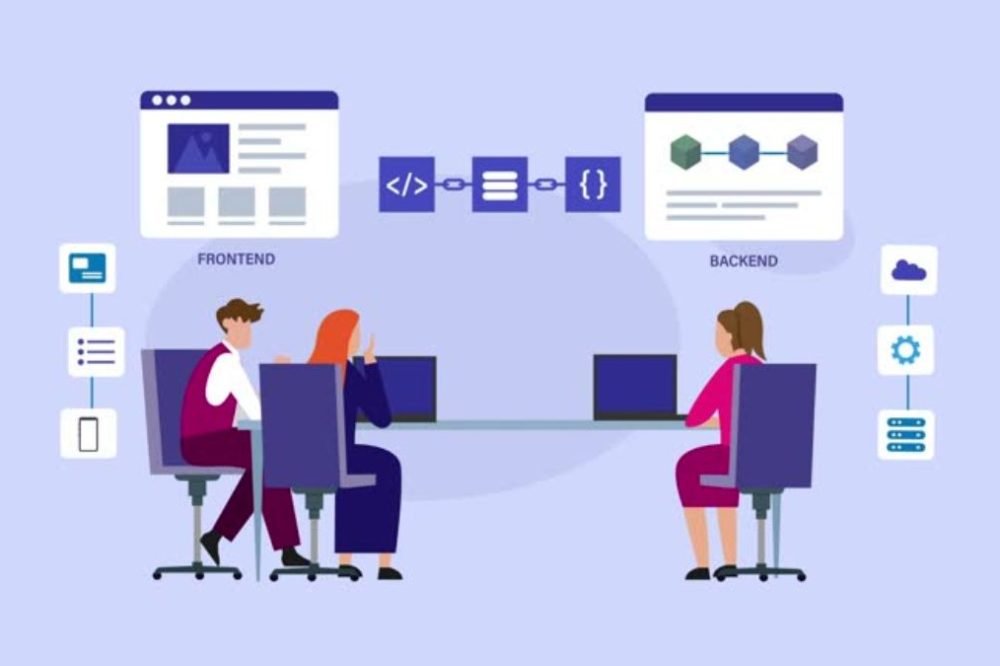
Every website or software that you use has two elements that function together. You have the part that you can see and touch and the part that truly makes everything work behind the scenes.You should know the difference between frontend and backend development for a reason. It’s not just a fun fact to know, it’s the first decision point for anyone interested in a career in tech. It affects what you’ll learn, what your day-to-day will look like, and even your income range.
In this post, I’ll explain the difference between frontend and backend development, the technologies each side employs in 2026, how they function together, and how to select which path would genuinely fit you.
The basic version
The frontend is what you see. things’s the backend that makes things function. That’s the main difference under everything else in this guide.
- Frontend development creates the part of a website or app that users see and interact with – the visual layer, which includes layout, design, buttons, and navigation.
- Backend development manages the server-side architecture, databases and business logic that causes the frontend to display what it displays – invisible to users, but responsible for everything functioning properly.
Think about a restaurant: the frontend is the dining room – the menu, the table arrangements, the way the space is organized and put up for the customer experience. The backside is the kitchen . This is where the real cooking takes place , where ingredients are stored , where orders are handled , all out of sight of the person sitting at the table .
What Frontend Development Actually Is
Frontend developers are responsible for the layout, design and interaction of a website or app – all the stuff a user directly sees, clicks, taps or scrolls thru. This comprises buttons, text, graphics, forms, animations, and the whole experience of navigating.
Main Frontend Technologies:
- HTML – the actual content of a page
- CSS – styles, lays out and designs visually
- JavaScript – adds interaction and dynamic behavior
React is still the dominating framework in 2026 . I see it being used a lot in enterprise stacks alongside Next.js . React allows developers to write reusable components , and handle complex application state without reinventing the wheel . For smaller teams, Vue.js is still a great, more approachable option, whereas Angular is still for large enterprise applications that benefit from its more structured and stricter norms.
What a frontend developer’s day-to-day looks like
Frontend developers tend to work very closely with designers and QA testers, and the workflow is based on a lot of visual testing and interface polishing. However, it is worth being honest about what “professional” frontend work really entails; basic frontend work can look like just styling pages, but real, professional-level frontend work involves fixing browser behavior quirks, accessibility requirements, client-side state management, full product flows, performance optimization, analytics integration, design systems, and every possible user state that emerges after a feature actually ships into the real world.
What is involved in Backend Development
Backend development deals with the database, server and application logic that actually makes a website or app work – the bits that accept a request, retrieve or change information, and give back the appropriate answer, which the user never ever sees.
Key Backend Responsibilities:
- Server logic – Receiving requests, processing them properly, and sending the right response
- Database administration – storing, retrieving, updating, and deleting data
- Designing a data model that is efficient and maintainable as the application grows
- Authentication and authorization- figuring out who a user is, and what exactly they’re permitted to access
- APIs- establishing the formal contract that enables the frontend ask for and receive data from the backend in a structured, predictable manner
Backend technologies in 2026: Modern backend systems are typically developed using server-side programming languages such as Python, Node.js, Go, Java, and others, selected based on the specific performance requirements, ecosystem, and team familiarity of a given project.
What does “professional” backend work actually mean: Basic backend work can look like simple CRUD endpoints (Create, Read, Update, Delete) — but real, professional backend engineering means handling data correctness under real-world conditions, authentication security, database migrations as the system evolves, observability into how the system is actually performing, genuine scaling as usage grows, security against actual threats (like the OWASP Top 10 vulnerability categories), integrations with other systems, and graceful handling of failures rather than a system that simply breaks when something unexpected happens.
How Frontend and Backend Really Work Together
The frontend and backend are not two separate competing systems, they are two sides of the same coin, talking continually to each other thru APIs. This is what happens in practice : the frontend asks for data ( e.g. a user ‘s order history ) and the backend provides it . Usually , the data is formatted as structured data , which the frontend then shows graphically to the user .
And this separation is intentional and really valuable . By building REST or GraphQL APIs as a formal documented contract between the frontend and backend teams (often using something like OpenAPI/Swagger for documentation), each side can be built, modified, and even completely replaced independently, as long as the API contract between them stays the same. That separation is what enables a company to rethink its visual interface completely without having to rebuild its underlying data infrastructure, or extend its backend independently as demand grows without changing the frontend at all.
Frontend vs Backend: Side by Side Comparison
| Frontend | Backend | |
|---|---|---|
| What it governs | Visual layer, interaction, layout | Server, database, business logic |
| Core languages | HTML, CSS, JavaScript | Python, Node.js, Go, Java, etc. |
| Common frameworks (2026) | React/Next.js, Vue.js, Angular | Express, Django, Spring, Laravel |
| Visibility | Visible and directly interactable by users | Invisible – operates on server |
| Feedback loop | Real-time visual feedback in the browser | More abstract . . . Logs Data states Requests |
| Common collaborators | Designers, QA test engineers | Other backend developers, DevOps, security |
| What failure looks like | Broken layout, unresponsive UI | Data problems, downtime, security incidents |
Which way should you go?
Neither one is universally “better” or “easier” – they’re both solid, well-paying career options in 2026, and they both need real depth once you get beyond the beginner-level job. One of the biggest mistakes people make is to compare the easiest version of one path to the hardest version of the other. This really distorts the picture of what each vocation actually entails at a professional level.
The frontend will usually fit you if:
- You want quicker, more instant visual feedback – you can open a browser and see the result of your work directly, which many novices find more motivating early on
- You are comfortable working directly with designers and thinking about user experience
- You love visual problem solving and interface-level craftsmanship
Backend is probably right for you if:
- You’re fine with reduced immediate visual clues, working with requests, responses, logs, and data models
- You thrive on systems-level thinking – the flow of data, the scalability of a system, how faults are handled
- You want the permanent engineering habits that result from working with input that is less immediate and more abstract.
Full-stack development involves working across frontend & backend – full-stack developers work on the whole application, from the interface to the server. In 2026, perhaps the most versatile combination in tech is the full-stack skillset and the ability to integrate AI tools into a workflow because a single developer can own a full feature from start to finish rather than relying entirely on another team to do the other half of the work.
Salary and Demand in 2026
There is still a lot of demand for front-end and back-end development – the U.S. Bureau of Labor Statistics estimates that positions for web developers will increase by around 7% between 2024 and 2034, with about 14,500 new job openings created each year. In general, backend developers tend to be paid a little more, since professional backend work entails more complex responsibilities around security, scalability and data accuracy. However, both disciplines offer high, competitive salaries and the difference isn’t that significant.
Worth noting: the market in 2026 doesn’t reward “I know a specific framework” nearly as much as it rewards engineers – frontend or backend – who can actually handle real product constraints: performance under real usage, security, accessibility, and the messy edge cases that only show up after a feature actually launches to real users.
Do I Have to Learn Both?
Not required, especially early on – but knowing at least the basics on both ends really helps even if you specialize on one end very heavily. A frontend developer who understands basic API design speaks orders of magnitude better with backend teammates, and a backend developer who has some frontend knowledge can better predict the impact of their API design decisions on the interface built on top of it. Full-stack understanding implies you don’t have to master everything at once, but you have enough working experience with both sides to work well together, and to work across the barrier as needed.
Abstract
Frontend vs backend is really just a matter of division. Frontend is what the end user sees and directly interacts with. Backend is the unseen infrastructure (server logic, databases, security, etc.) that makes those interactions really work correctly. If you go beyond entry-level work, each position requires real depth and experience. Neither is easier or more valued than the other. Both have solid and rising job opportunities in 2026.
If you’re trying to pick between the two, don’t pick based on which one’s easiest demo looks cooler-pick based on whatever kind of challenging, professional-level work you’re actually willing to put time into practicing and getting better at over time. Frontend is for the visual, user-experience-centric issue solvers who like instant feedback; backend is for the systems thinkers who are comfortable with more abstract signals (logs, data models) and who can conceive in terms of systems. Whichever road you take, knowing how the other half actually works can make you a better and more effective developer no matter what your specific area of expertise.
Common questions
1. Is it easier to learn frontend or backend development?
Since it’s more visual, frontend is generally regarded more approachable for total beginners – you can open a browser and see the effect of your code immediately. It can seem more abstract at first because there are no clear visual feedbacks, only requests, data models and logs yet it develops durable engineering habits fast. And neither really is “easier”, until you get to professional-level depth in either area.
2. Which programming languages should I learn for frontend and backend?
Frontend development is largely HTML, CSS and JavaScript, often using a framework like React, Vue.js or Angular. The languages used for the backend development are Python, Node.js, Go or Java, with a database and server framework suitable for the language environment.
3. Define for me what a full-stack developer is?
A full-stack developer develops front-end and back-end applications and manages a program from the user interface to the server and database. with the coupling of full-stack skills with the ability to appropriately integrate AI tools is one of the most flexible and in-demand combos on the 2026 labor market.
4. Are salaries for backend and frontend developers different?
Back-end devs tend to get paid a little more than usual, which makes sense as professional back-end work involves the added complexity of security, scalability, and data-correctness duties. That said, both fields are lucrative and competitive and the difference between the two of them is not huge relative to the overall demand for both positions.
5. If I am a newbie, should I learn front end, back end or both?
For most newbies, it’s best to start off with one side-frontend if you want rapid visual input, backend if you are drawn to systems and data—and establish genuine depth there before branching into the other. Even a cursory awareness of the side that you don’t own makes you dramatically more effective at working with the team members that do own that half of the application.

Enjoyed this article?
If this guide helped you, consider supporting Rough Diary. Your support helps us continue creating practical, informative, and useful AI and technology content.