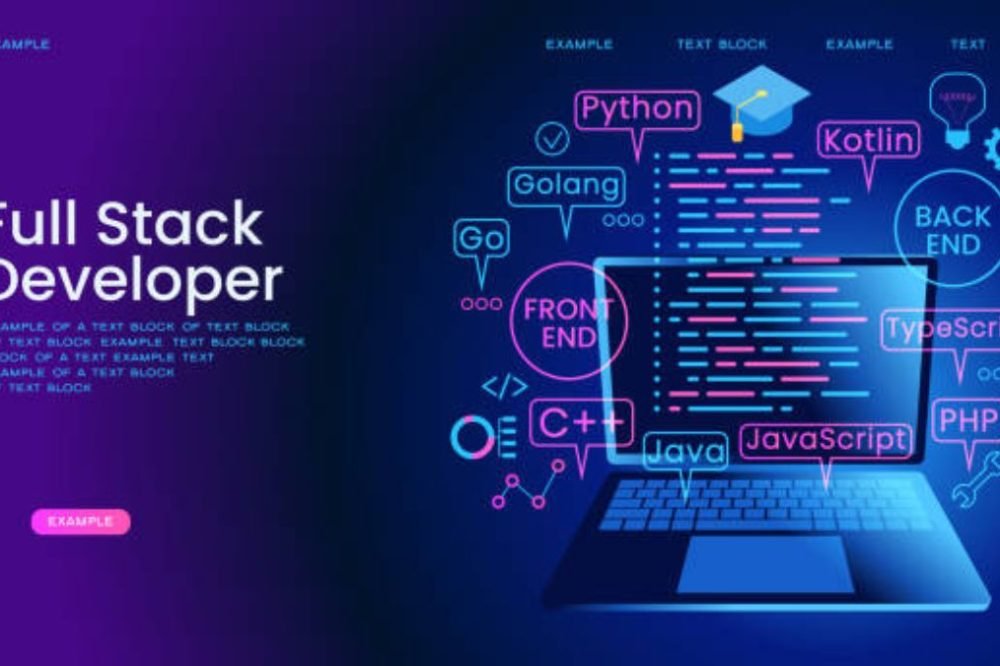
Take a restaurant, for example. The guests really only see the dining room, but all the real work, the cooking, goes on in the kitchen, unseen by the guest. A full-stack developer is someone who can work in both places — developing the visual interface a user clicks through, and building the server logic, database and infrastructure that makes that interface actually function. It’s one of the most diverse positions in computing, and it’s still legitimately in demand: The U.S. Bureau of Labor Statistics forecasts software developer employment to expand 15% through 2034, with around 129,200 openings each year, faster than the average for all occupations.
In this tutorial, we’ll explain what a full-stack developer is in simple words, outline crucial abilities, and give a practical and contemporary 2026 route to become one.
What Is a Full Stack Developer?
A full stack developer is a software engineer who works on the front-end (the user interface, developed with HTML, CSS and JavaScript/React) and the back-end (server logic, APIs, and databases, built with technologies like Node.js, Java or Python). They know the entire lifecycle of a web application – design, create, deploy and maintain and they don’t restrict themselves to a single layer of the stack.
This breadth is of practical importance, and not only theoretical. Startups are more likely to recruit full stack engineers to create and ship products fast with a small workforce. In larger companies they provide value by crossing teams and making sure that features are actually done from design to functionality rather than becoming trapped in handoff delays between different frontend and backend specialists. That same breadth offers them the freedom to do both design and development in freelance work without having to bring on a second contractor.
Five Skill Clusters That Really Define the Role in 2026
Full-stack development in 2026 is not just “knowing React and Node.js” anymore – the position has truly broadened into five different skill clusters and the developers getting hired are the ones that go deep across all five rather than shallow across dozens of disparate technologies.
1. Front end Development
- HTML, CSS and JavaScript – the non-negotiable foundation JavaScript has been the world’s most-used programming language for over a decade, used by roughly 62% of all developers according to Stack Overflow’s survey data
- TypeScript – no longer optional in 2026 43.4% of professional developers now use it, making it a genuine baseline expectation in production full-stack roles rather than a nice-to-have
- React, a front-end framework, continues to be the most popular, with an estimated 44%+ of projects globally using it, and the largest hiring pool of any front-end framework. It is typically combined with Next.js for production apps.
2. Back-end development
- A server-side language – Node.js (Javascript on the backend), Python or Java are most common. The “MERN stack” (MongoDB, Express, React, Node.js) has become the default choice for startups and mid-size companies specifically while Java Full Stack remains the highest paying and most in-demand combination in enterprise, banking and fintech hiring.
- RESTful APIs – understanding how the frontend and backend actually communicate, typically exchanging JSON data through well-structured API endpoints.
- Authentication and authorization – creating secure login systems and managing access for different people
3. Database’s
- Relational databases (SQL) – PostgreSQL has really eclipsed MySQL in terms of developer usage. It was sitting at roughly 49% adoption among developers. Making it the safer default choice to learn in 2026.
- NoSQL databases – MongoDB is the default choice for flexible data in document format – especially popular in MERN-stack applications
4. DevOps and Deployment
- Git and version control – really required, not optional. Knowledge of Git-based platforms like GitHub and GitLab is a baseline necessity for any full-stack position
- Cloud Platforms – Experience installing apps on one or more of the main cloud providers (AWS, Azure, Google Cloud) for hosting and deployment
- Containers and the 12-factor app methodology – Docker and container-based deployment are now the standard requirements for cloud-native development
- CI/CD basics – understanding how code flows from a developer’s machine to testing and into production reliably
5. Development with AI Assistance
- This is really the latest thing added to the complete stack skill set and any 2026 roadmap that doesn’t consider it is already out of date. AI coding assistants have changed day-to-day coding, but they haven’t replaced the need for developers who understand architecture, can debug production issues, and can translate business requirements into working software – if anything, knowing how to work effectively alongside AI coding tools is itself an expected skill, not a replacement for the fundamentals above it.
Choosing your Stack: MERN versus Java Full Stack vs Others
A “tech stack” is essentially the collection of languages, frameworks, and tools that you’ll actually employ to construct apps. Two most probable scenarios in 2026:
- MERN (MongoDB, Express, React, Node.js) – The all-JavaScript stack, the preferred option of startups and mid-size organizations nowadays, and the one with the broadest worldwide recruiting pool thanks to React’s and Node’s dominance
- Java Full Stack – couples a Java backend (typically Spring Boot) with a frontend framework. It is the highest paying and most in-demand combination notably for corporate, banking, and fintech employment. It is especially strong in certain regional markets such as Indian enterprise hiring.
Other stacks worth understanding about include the JAMStack (JavaScript, APIs, Markup), a new “headless” architecture that’s known for speed and scalability and is gaining popularity for content-driven sites and applications that don’t need a traditional, tightly-coupled backend.
Practical guidance: if you don’t know which one to choose, MERN has the widest and worldwide applicable employment pool for a first job. Opt for Java full stack only if you know you want to work for corporate, banking or fintech businesses or are in a place where that combo is the local norm.
Roadmap to Becoming a Full Stack Developer – A Step-by-Step Guide
- Internet and web foundations – get a good handle on how the web works (HTTP, DNS, how a browser generates a page) before jumping into any specific technology
- HTML5 and CSS3 – the building blocks of every web page
- JavaScript, then TypeScript – learn JavaScript first, then go on to TypeScript when you’re comfortable, as it’s now a baseline expectation in production roles
- Git and GitHub – version control from the start, not just when you’re constructing bigger projects
- A frontend framework – React (with Next.js) for the broadest recruiting pool, or an alternative if your target market prefers it.
- A backend language and framework – Node.js/Express if you’re going MERN, or Java/Spring Boot if you’re going the Java Full Stack route
- Databases – PostgreSQL for relational data, MongoDB if you’re going the MERN route specifically
- REST APIs and authentication – building the actual communication layer and secure login systems between the frontend and backend
- DevOps basics – Docker, a cloud platform, and basic CI/CD concepts
- Testing – developing tests for both frontend and backend code, a skill that’s becoming more of an expectation than just optional polish.
- Deployment – deploying a real, live program, not just running it locally.
- AI-powered dev tools – how to work well with AI coding assistants as part of a modern dev process
Realistic Time Frame
Most sources seem to agree on a rather constant range: 6-9 months of continuous, daily practice for learners on a planned path, stretching to 8-12 months for those starting from absolute scratch with larger foundational gaps to bridge first. The number one reason self-taught learners lose steam after a roadmap like this isn’t the technology itself — it’s trying it without structure, without feedback, without accountability, which is exactly why pairing a roadmap with real projects, code review, and a community or mentor (formal or informal) dramatically improves the odds of actually finishing.
Building Real Projects: The Part That Matters Most
Almost all credible roadmaps give the same single piece of advice: the best way to learn is to build projects, mess up, and rectify your mistakes. Not watch endless videos. Start small, build bigger, and approach each project as teaching you something specific that the past one didn’t. A good project portfolio, cloud abilities and real system design ability constantly push a full-stack developer’s compensation far over the median for their experience band. This is significantly more important than any individual technology on a resume.
Full-Stack Developer Salary & Demand 2026
Looking ahead to 2026, demand for full-stack engineers remains robust, driven by digital transformation, the use of AI to drive product development, and continuous rise in remote employment. As teams shrink, the ability to travel over the stack without needing to be led by the hand cuts down on handoff delays, which is a structural reason why full-stack skills remain valued even as the larger IT employment market has cooled in some sectors. And thus companies increasingly are looking for workers who can do that.
Conclusion
What do you mean by full stack developer? A person who can work on the frontend, the part of the web application that a user sees, and the backend infrastructure that makes it operate, comprehending the whole lifecycle from design to deployment. The role has in fact grown in 2026 to five real clusters of skills. Frontend, backend, databases, devops and AI-assisted development. The best hires are those that go deep in all five clusters, not shallow in dozens of trending technologies.
Becoming a full-stack developer is 100% doable even if you start from zero, and the roadmap is very simple: learn the basics of the web, choose a stack (MERN for the biggest pool of hiring, Java Full Stack for the enterprise-oriented ones), constantly create real projects, learn how to deploy what you create, and add AI tools into your workflow rather than avoiding them. But most importantly, don’t wait until you’re 100% “ready” to start constructing – the projects themselves are really where the true learning happens, faults and all.
Frequently Asked Questions
1. How does a full-stack developer vary from a frontend or backend developer?
A frontend developer is concerned with the user-facing interface (layout, design, interactivity), while a backend developer is concerned with server logic, databases and infrastructure.
2. How Long Does It Take to Become a Full Stack Developer in 2026?
If you follow a roadmap and practice every day, most learners are ready for a job in 6-9 months. Some sources say 8-12 months if you are beginning from scratch. This timeline is more about consistency and producing real projects than which exact technology you want to study.
3. MERN stack or Java Full Stack?
MERN (MongoDB, Express, React, Node.js) has the biggest worldwide employment pool and is the preferred choice for startups and mid-size organizations. Java Full Stack is the highest paying and most in demand combo in enterprise, banking and fintech hiring especially – select based on the company type and region you are actually looking for.
4. Do I need to understand AI tools in the full stack developer roadmap?
Yes, for real – AI-assisted development is one of the five main skill clusters that will define the function in 2026, and a strategy that doesn’t consider working successfully with AI coding assistants is already out of date. However, the necessity for developers who understand architecture, can diagnose genuine production difficulties, and can convert business needs into workable software has not been replaced by AI technologies.
5. Is it better to know a lot of technologies or to have good projects to get a full-stack developer job?
Strong, meaningful initiatives always beat out breadth of technology alone. Developers hired in 2026 will be those who go deep on the 5 core skill clusters (frontend, backend, databases, DevOps, AI-assisted development) rather than shallow on many trending frameworks. A strong project portfolio, cloud skills, and system design ability most consistently push pay above the median for a given experience level.

Enjoyed this article?
If this guide helped you, consider supporting Rough Diary. Your support helps us continue creating practical, informative, and useful AI and technology content.