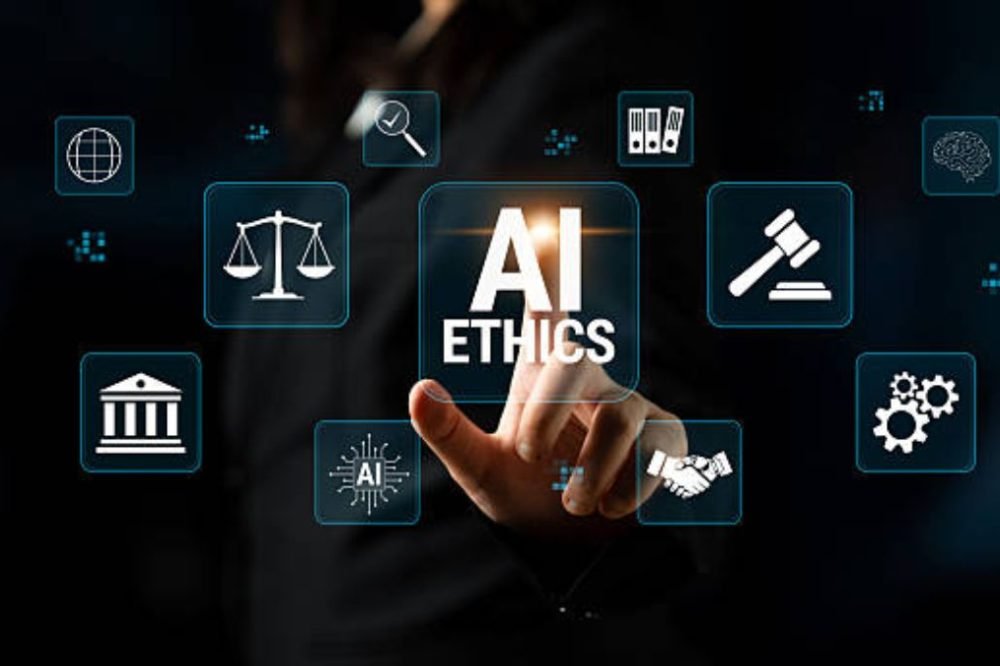
AI systems now sit quietly behind decisions that shape people’s lives – who gets a loan, which résumé gets a callback, what medical information a patient receives, what content millions of people see first thing in the morning. Stanford’s 2026 AI Index describes a year in which model capability, investment, and adoption keep climbing, while public trust and governance capacity are visibly lagging behind that growth. That gap between what AI can now do and how confidently society can govern it is essentially the whole story of why AI ethics has moved from an academic subfield into a genuinely urgent, practical concern in 2026.
This guide explains what AI ethics is in plain language, the specific issues driving the conversation this year, and why it matters well beyond the tech industry itself.
What Is AI Ethics, in Plain English?
AI ethics is the research and practice of ensuring that artificial intelligence systems are developed and deployed in ways that are fair, transparent, accountable, and really beneficial to humans – rather than harmful, discriminating, or opaque. It sits at the intersection of two related but distinct things: AI ethics as an academic and philosophical field, examining the moral, social, and political questions AI raises, and AI governance as the practical, operational side – turning “be ethical” into specific policies, processes, and accountability structures that organizations actually follow when building and deploying these systems.
Researchers commonly split the field into two related subareas: robot ethics (questions specific to physical, embodied AI systems) and machine ethics (broader questions about how any AI system should be designed to behave, and who’s responsible when it doesn’t).
The Core Issues AI Ethics Actually Addresses
Bias and Fairness
AI systems learn from data, and if that data reflects existing stereotypes or historical inequalities, the AI can repeat or even amplify them – in hiring tools, lending algorithms, healthcare recommendations, or content moderation systems. This isn’t a hypothetical concern; it’s one of the most extensively documented and studied AI ethics issues, precisely because biased training data produces biased outputs even when no one involved in building the system intended discrimination.
Transparency and Explainability
Many AI systems function as “black boxes” – even the people building them can’t always fully explain why a specific output or decision came out the way it did. This becomes a genuinely serious problem once AI is used for decisions that materially affect people’s lives, like healthcare or financial outcomes, where an affected person has a real interest in understanding why a decision was made. Pressure is building on developers in 2026 to adopt genuinely explainable AI principles, and on organizations to implement real auditing methods for their AI-driven decision-making, rather than treating explainability as optional.
Accountability Without Access
This has emerged as a distinctly 2026 framing of an older problem: a small number of companies control the concentrated inputs AI genuinely depends on – advanced chips, large cloud platforms, proprietary model weights, and the data and compute needed to train frontier systems. A small developer, school board, hospital, or local government may end up relying on an AI service without ever seeing the training data, evaluation results, or safety testing behind it- and contract language can assign legal responsibility to the buyer even when that buyer has no realistic way to audit the system they’re using. The ethical problem here isn’t scale itself, which can genuinely produce better, more secure, and more affordable tools — it’s accountability that doesn’t come paired with real access or oversight.
Agentic AI and Autonomy
As AI agents – systems capable of carrying out complex, multi-step tasks with minimal human involvement – become more common, a genuinely new set of questions has emerged: how far should an autonomous system be allowed to act without human oversight, and who’s actually responsible when something goes wrong? Legislators are expected to grapple directly with autonomy thresholds in 2026 — how much human oversight should be legally required for different categories of AI action, and what penalties should apply when organizations let autonomous systems act irresponsibly.
Privacy
AI systems, particularly large language models, are often trained on vast datasets that can include personal information, and questions about consent, data ownership, and appropriate use remain genuinely unresolved in many jurisdictions. Legal disputes over data scraping and training practices have become a recurring, real feature of the AI landscape rather than a one-off controversy.
Misinformation
AI can produce content that looks entirely credible but is factually false, at a speed and scale that makes it genuinely harder to contain than earlier forms of misinformation – a concern that extends well beyond obvious “deepfake” cases into more subtle, everyday misuse.
Economic Disruption and the Jobs Question
AI-driven automation is displacing certain roles, particularly those involving repetitive or highly predictable tasks, while simultaneously creating new ones – current estimates project roughly 85 million jobs displaced against roughly 97 million new roles emerging, a net global gain, though a real and significant skills gap exists, since a large share of the newly created AI-related jobs require advanced degrees. This is a genuinely contested area where reasonable people disagree on the net social impact, the right policy response, and the appropriate timeline for adjustment – treat any confident, singular prediction about the labor market’s future with real skepticism.
The Regulatory Landscape in 2026
2026 marks a genuine turning point for AI regulation globally, most notably with the EU AI Act coming fully into force – the world’s first comprehensive legal framework specifically for artificial intelligence. It sets tough criteria for “high-risk” artificial intelligence systems, such as those used in recruitment, education and healthcare, and covers issues like as risk assessment and data quality, transparency and oversight by humans.
Outside the EU, the regulatory landscape is highly fragmented. The US today has more partial, sector-specific guidance than one comprehensive federal framework, while countries like Brazil, South Africa and Indonesia are still actively developing their own approaches. This fragmentation itself is a real, practical barrier. Artificial intelligence systems and the firms generating them are global, yet the rules that govern them remain mostly national. This creates substantial compliance difficulties for any organization operating across borders. It is indeed an open topic – and one on which sensible observers dispute – whether 2026 will see global governance frameworks converging toward shared standards, or fragmenting further into incompatible regional systems.
Why AI Ethics is Important Outside the Tech Industry
Here public trust counts for a very practical reason: Artificial intelligence (AI) technologies increasingly mediate access to labor, information, financial services, health care and public services, so failings of justice, transparency or accountability don’t remain in the tech industry.. They show up directly in whether someone gets approved for a loan, whether a résumé gets a fair look, or whether a patient receives accurate medical guidance.
There’s also a genuine timing argument driving urgency in 2026 specifically: a “move fast and fix later” approach may be tolerable in low-stakes consumer software, but it’s considerably more dangerous when applied to AI systems determining creditworthiness or medical treatment. Once such systems are deployed at scale, retrofitting ethical safeguards afterward is slower, more expensive, and harder to enforce than building them in from the start – a real, practical reason organizations are increasingly treating AI ethics as a core design principle rather than an afterthought bolted on after deployment.
What Responsible AI Actually Looks Like in Practice
Ethical AI in 2026 is increasingly understood as requiring organizations to treat transparency, accountability, and fairness as genuine core business priorities, not just compliance checkboxes to satisfy after the fact. In practical terms, this tends to include: bias testing and auditing before and after deployment, clear documentation of how and on what data a system was trained, defined human oversight requirements for consequential decisions, and genuine accountability structures specifying who is responsible when something goes wrong -turning abstract ethical principles into specific, evidence-based operational practice rather than aspirational language in a mission statement.
Different Perspectives Worth Knowing
It’s worth being clear that AI ethics is a genuinely contested field, not a settled consensus with a single correct answer. Some researchers and organizations emphasize near-term, concrete harms – bias, misinformation, job displacement, privacy – as the priority. Others focus more on longer-term, harder-to-predict risks tied to increasingly autonomous and capable AI systems. There’s also a wide divergence of opinion about the optimal regulatory strategy. Some push for tight, comprehensive frameworks like the EU AI Act; others fret that heavy regulation will stifle good innovation or favor the largest, best-resourced corporations that can most readily absorb compliance expenses. There’s no single “correct” position across this field, and thoughtful, well-informed people land in genuinely different places on these questions.
Conclusion
What is AI ethics, and why does it matter in 2026? At its core, it’s the effort to ensure increasingly powerful and autonomous AI systems are built and deployed in ways that are fair, transparent, and genuinely accountable – a challenge that’s moved from academic discussion into urgent practical necessity as AI systems increasingly mediate real decisions about people’s work, finances, health, and access to information. Bias, transparency, accountability without meaningful access, agentic AI autonomy, privacy, and economic disruption are the core issues driving the conversation this year, playing out against a genuinely fragmented global regulatory landscape anchored by the EU AI Act’s arrival as the first comprehensive framework of its kind.
Whether you’re a student, a business leader, a policymaker, or simply someone whose daily life increasingly runs through AI-mediated systems, understanding these issues in plain terms – not through either uncritical hype or uncritical alarm – is genuinely useful. The organizations and societies that navigate this well in the coming years will likely be the ones treating etics as a foundational design principle from the start, rather than a costly retrofit applied after problems have already caused real harm.
Frequently Asked Questions
1. How is AI ethics different from AI governance?
AI ethics is the academic and philosophical study of the moral, social and political dilemmas that arise from artificial intelligence. AI governance is the pragmatic, operational aspect – putting ethical ideas into concrete rules, accountability frameworks and repeatable practices that enterprises actually follow, the mechanism that makes ethical intent enforceable rather than aspirational.
2. Why is transparency such a crucial thing in AI ethics?
Many AIs are run as “black boxes”; even their creators can’t always completely explain a single output or decision. This is really serious when AI is used to make consequential decisions-healthcare, lending, hiring-where people affected have a real interest in understanding why a particular outcome occurred, and where a lack of explainability makes both accountability and error-correction much harder.
3. What is the EU AI Act and why does it matter in 2026?
The EU AI Act is the world’s first comprehensive legislative framework exclusively for artificial intelligence, which will fully come into action in 2026. It places strict demands on “high-risk” artificial intelligence systems – including those used in hiring, education and healthcare – around risk assessment, data quality, transparency and oversight by humans. It is widely seen as a real test case for whether all-encompassing AI regulation can work in practice.
4. Will AI actually cause net job losses?
This remains a genuinely contested question. Current estimates suggest roughly 85 million jobs may be displaced against roughly 97 million new roles emerging – a net global gain on paper – but a significant skills gap exists, since many newly created AI-related roles require advanced degrees. Reasonable experts disagree substantially on the real net social impact and the right policy response, so this is an area worth treating with genuine caution toward any single confident prediction.
5. Is there a single, agreed-upon approach to AI ethics?
No – AI ethics is a genuinely contested field rather than a settled consensus. Views differ on which risks matter most (near-term harms like bias versus longer-term risks from more autonomous systems) and on the right regulatory approach (comprehensive frameworks like the EU AI Act versus lighter-touch approaches). Thoughtful, well-informed people land in different places on these questions, and that disagreement is a genuine, ongoing part of the field rather than a sign it’s unresolved due to lack of attention.

Enjoyed this article?
If this guide helped you, consider supporting Rough Diary. Your support helps us continue creating practical, informative, and useful AI and technology content.