A smart contract is like a vending machine, you may think of it as: You put your money in, pick out the item and the machine instantly gives it to you. No cashier, no bargaining, no waiting for someone to approve the transaction. It does exactly what it is programd to do, every time, for every person. A smart contract achieves the same thing, except it’s for digital agreements instead of food. It puts the rules of the agreement in code and when the criteria are met, it executes automatically. No middleman has to approve each individual transaction, and the regulations cannot be changed retroactively.
This article will tell you what a smart contract really is, how they function and real life examples that are running now, as well as the real risks that are worth knowing about before you regard the technology as a magic answer to every form of agreement.
What is a Smart Contract? In Simple Terms
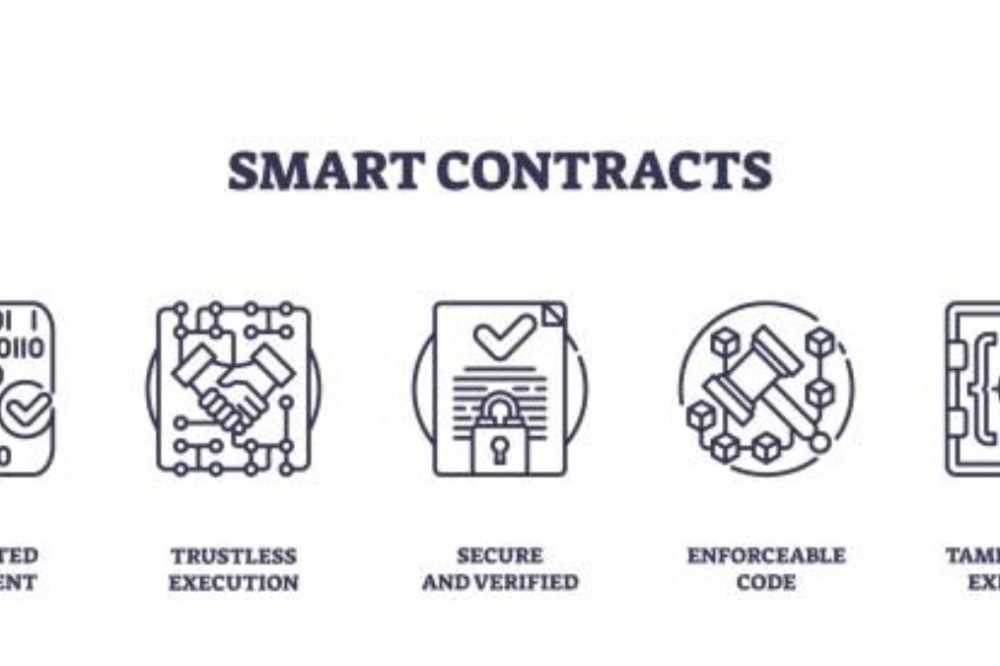
A smart contract is a self-executing program on a blockchain that automatically enforces the terms of an agreement between parties when certain predetermined criteria are satisfied. More formally, NIST defines it as code and data deployed to a blockchain, executed by network nodes, with the results recorded on-chain. This technical definition highlights the two features that actually make intelligent contracts valuable to businesses: deterministic execution (the same input always produces the same output, with no room for a middleman’s discretion) and tamper-resistant recordkeeping (once deployed, the contract’s logic can’t be secretly altered).
Smart agreements do not require a trusted third party — a bank, lawyer, or escrow agency — to enforce an agreement. Instead the contract is the automatic , neutral enforcer . If requirements are met then the contract executes , if not then it doesn ‘t .
How a Smart Contract Really Works
- The conditions of the agreement are directly encoded in the code – the simplest pattern is “if payment is made, then transfer ownership of the asset” but actual contracts can include far more intricate conditional logic.
- The contract is deployed to a blockchain, which means its code is visible, verifiable, and (in most implementations) immutable-it cannot be secretly updated after deployment.
- The contract is on hold for its trigger requirements to be met: a payment to be received, a delivery to be verified, a certain date to be reached, or external data to pass a certain threshold.
- The contract executes automatically when requirements are met. No manual approval step. No waiting on a human to handle the transaction.
- The result is coded on-chain, leaving a permanent, publicly verifiable record of what took place and when.
This is where oracles come in. Oracles are external data services that bring real-world information to the blockchain so a contract may act on it. For data that doesn’t naturally live on a blockchain – weather conditions, a delivery confirmation, an off-chain pricing feed – intelligent contracts rely on oracles. This is a very significant point, because a smart contract is only as good as the data that feeds it; a defective or manipulated oracle can cause a contract to execute improperly even when the contract’s own code is working exactly as stated.
Smart Contract Real World Examples 2026
Rather than general musings about the potential of intelligent contracts, it’s worth being explicit about what is currently running today:
- Decentralized exchanges (DEXs) Smart agreements on Uniswap and similar platforms enable users to trade bitcoin directly with one another, without the need for a traditional broker or exchange operator in the middle. In a recent year, smart contract-powered decentralized exchanges alone handled more than $1 trillion in trade volume – actual money moving through automated code instead of banks or brokers.
- NFTs platforms. When you buy an NFT on a site like OpenSea , a smart contract does the transaction directly : You send the money , the NFT gets to your wallet . This same contract can also automatically enforce creator royalties, delivering a percentage of every future resale back to the original artist without any manual tracking or invoicing.
- DeFi financing platforms. Platforms like Aave enable users to lend and borrow crypto without a loan officer, credit check or waiting period – every rule of lending is enforced programmatically via the smart contract, including collateralization and liquidation conditions.
- Stablecoins backed by collateral.Users can deposit collateral into a smart contract vault and issue a stablecoin against it, using protocols like Sky Protocol (previously MakerDAO). The contract will automatically liquidate the vault when the collateral value falls below a certain safety level and does not require any human involvement to enforce that restriction.
- Parametric insurance. Some insurers are increasingly employing intelligent contracts that automatically settle claims when external data is validated. For example, a crop insurance contract may instantly pay out if an oracle reports that rainfall in a certain location was below a certain amount, with no claims process, paperwork or adjuster involvement.
- Supply chain payments. Smart agreements can be an advantage for supply chains by automatically releasing payment once the delivery terms have been agreed, which reduces disagreements and frees up working capital that would otherwise be tied up in human reconciliation.
What Blockchain Platforms Provide a Smart Contract in Standard Form?
There are several blockchain ecosystems supporting smart contract technology, each with its own trade-offs:
- Ethereum is the most popular smart contract platform, and has the largest developer community. Contracts are generally developed using a programming language called Solidity and executed on the Ethereum Virtual Machine (EVM).
- Solana’s unique consensus method allows it to boast high throughput and minimal transaction fees, making it appealing for high-volume use cases.
- Other platforms have come along with their own particular strengths, and the appropriate decision for a given project will generally come down to the particular mix of throughput, cost, security track record and developer ecosystem maturity that matters most for that use case.
Intelligent Contracts with Real Benefits
- No intermediaries – transactions can happen directly between parties without a lawyer, bank or broker processing and approving each transaction manually.
- Speed – conventional finance settlement cycles that traditionally took days may be done on-chain in minutes.
- Reduced disputes – the contract logic is transparent, predictable and automatically enforced. This leaves less room for the kind of interpretation issues that fuel many traditional contract problems.
- Transparency and auditability – When deployed, the logic of a contract and its history of execution can be verified by anybody in the public domain, not hidden behind the internal mechanisms of a private entity.
- Lower administrative costs By automating the reconciliation, documentation and staff time that would otherwise be required, overhead is dramatically reduced at scale.
Actual Dangers and Limits
It’s worth stating the actual risks clearly, because this is exactly the portion that excessively optimistic explainers skirt over:
- Code is law, bugs included. Intelligent contracts run exactly as programmed, therefore any programming error will execute exactly as programmed, as well. Therefore, smart contract hacks have caused major real-world financial losses across the sector, since a defect can’t be retrospectively “fixed” for transactions that have already taken place under it.
- Immutability is a double edged sword. The same tamper-resistance that makes a contract trustworthy also means that a mistake or weakness, once deployed and exploited, often can’t be discreetly patched the way traditional software can.
- Oracle Risk A smart contract that depends on external, real-world data is only as good as the oracle providing it that data; a compromised or malfunctioning oracle might cause a contract to execute based on bad information, even if the contract itself is perfect.
- While the regulatory landscape has evolved greatly since the early days of the technology, regulatory ambiguity is still a major issue in many jurisdictions, especially for financial and tokenized-asset use cases.
- Integration complexity, not just tech risk. Outside of DeFi specifically, many of the proposed use cases – supply chain management, digital identification, legal contracts – are hampered more by the practical issue of integration with existing business systems than any limit in the underlying technology itself.
Conclusion
A smart contract is essentially a simple idea expressed in complex terms: a collection of rules written in code that automatically and impartially executes when its criteria are met, without requiring a trusted third party to approve each particular transaction. The vending machine example works well because it provides a single image that encapsulates both the attraction and the danger: consistent, unbiased, predictable execution, but only as good as the rules it was really programd with, and unable to apply judgment if something unexpected happens. There is real, tangible value running via intelligent contracts today, especially in decentralized finance, but it’s the understanding of what they solve and where they might truly fail that differentiates educated adoption from naïve enthusiasm.
FAQ’s
1. Simply put, what is a smart contract?
A smart contract is a computer program that lives on a blockchain and automatically executes the terms of a contract when certain conditions are met – like a vending machine that automatically gives you an item once you put the payment in, without the need for a person to approve the transaction.
3. Are intelligent contracts genuinely legally-enforceable contracts?
This depends on the country and the use case, and regulatory clarity is still developing in many countries. Some intelligent contracts are designed to serve as the enforcement mechanism for a regular legal agreement, while others are more self-contained financial or transactional logic without a direct traditional legal equivalent. I think that’s worth seeing as a really dynamic field rather than a settled question.
3. What if there is a problem in a smart contract?
Smart agreements execute exactly as intended , which means that a problem in the smart contract code is executed exactly as written . The immutability that makes a contract trustworthy also means that a flaw generally can not be silently rectified after deployment the way that traditional software can . This has resulted in real, considerable financial losses throughout the industry from exploited vulnerabilities, and is one of the most critical risks to grasp before depending on smart contract technology for high-value use cases.
4. What is an oracle and why is it important to intelligent contracts?
An oracle is an external data provider that supplies real-world information such as weather data, delivery confirmations or price feeds into the blockchain so a smart contract can act on it. Intelligent contracts cannot inherently access anything beyond the blockchain. So if the smart contract depends on real-world conditions, the reliability of the smart contract is only as good as the reliability of the oracle that is providing the data to the smart contract.

Enjoyed this article?
If this guide helped you, consider supporting Rough Diary. Your support helps us continue creating practical, informative, and useful AI and technology content.