Ask five different people which AI chatbot is “the best” and you’ll get five confident, completely different answers. That’s not because any of them are wrong. It’s because the honest answer depends entirely on what you’re using it for, and most comparisons online skip that part in favor of a simple ranking that doesn’t hold up once you actually start using these tools for real work.
If you’ve already gone through our roundup of free AI tools worth using, this is the deeper dive into the specific decision most people get stuck on first: which chatbot should actually be your daily driver.
What Each One Is Actually Built Around
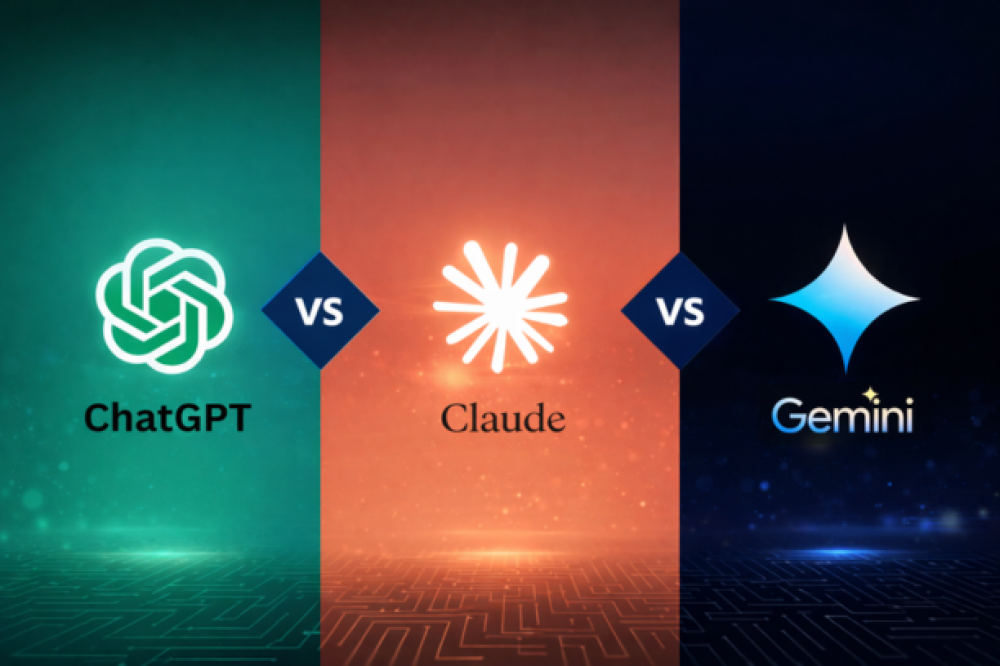
ChatGPT has the broadest ecosystem of any AI chatbot right now. It’s not just a chat window anymore, it’s built to browse the web, generate images, write and run code, and increasingly act as an agent that completes multi-step tasks on your behalf rather than just answering a single question. If you want one tool that handles a wide range of different tasks without switching apps, ChatGPT covers the most ground.
Claude tends to feel noticeably different in how it handles writing and reasoning. Responses often come across more careful and less generic, particularly for longer, nuanced writing tasks, document analysis, and situations where you want the model to actually think through a problem rather than pattern match to a quick answer. People who spend a lot of time on writing, editing, or working through complex documents often find it holds up better over long sessions.
Gemini has the advantage of being deeply built into Google’s ecosystem, which matters a lot if your daily work already lives inside Gmail, Docs, and Sheets. Asking it to summarize an email thread or pull information directly from a document you’re working in feels far more seamless than copying and pasting between separate apps, which is where the other tools still create friction.
Comparing Where It Actually Matters
For everyday writing and editing, Claude and ChatGPT both perform well, though Claude tends to be favored by people who specifically write longer form content, since it tends to keep a more consistent voice across a longer response instead of drifting into generic phrasing halfway through.
For coding help, ChatGPT and Claude are both strong, with Claude in particular gaining a reputation among developers for handling larger codebases and multi-file context more reliably, which matters once you’re working on something bigger than a single function.
For research and web-based questions, ChatGPT’s browsing capability is more mature and widely available, making it a stronger choice when you need current information pulled directly from the web rather than just what a model already knows.
For working inside existing documents and spreadsheets, Gemini has a clear edge purely because of how tightly it’s integrated into Google’s tools, saving the extra step of moving information between separate apps.
For multi-step task automation, this is where things have shifted fastest. If you’ve looked into what ChatGPT agents can actually do, you already know this category has moved well past simple chat responses into tools that can complete entire workflows with minimal supervision, and it’s worth understanding before assuming a chatbot is only good for answering questions.
Free vs Paid: What You’re Actually Missing on the Free Tier
All three offer usable free plans, but the gap between free and paid tends to show up in three specific places. Response speed slows down noticeably on free tiers during high traffic periods, usage limits mean you’ll hit a cap faster than expected if you’re using it heavily throughout the day, and access to the most capable underlying model version is often reserved for paid subscribers, with free users getting a lighter version that performs noticeably worse on complex tasks.
For occasional, everyday use, free tiers across all three are genuinely fine. For anyone using these tools as a core part of their actual job, whether that’s writing, coding, or research, the paid tier difference becomes noticeable fast enough that it’s usually worth the monthly cost.
Common Mistakes People Make Choosing Between Them
Assuming one is objectively “smarter” than the others. All three are built on frontier level models that perform similarly on most everyday tasks. The real differences show up in specific use cases, integration, and interface, not raw intelligence in a way you’d notice day to day.
Sticking with whichever one they tried first out of habit. A lot of people default to whichever chatbot they happened to sign up for first, without ever testing whether a different one actually fits their specific workflow better.
Not testing with their own real tasks. Generic online comparisons test the same handful of demo prompts. The only comparison that actually matters is running your own real, repetitive tasks through each one and seeing which produces output you’d actually use with the least editing.
Ignoring privacy settings entirely. Each of these tools has different default settings around whether your conversations are used to train future models. If you’re discussing anything sensitive, whether personal or work related, it’s worth checking and adjusting these settings directly rather than assuming.
So Which One Should You Actually Pick
If you want one tool that handles the widest range of tasks, including browsing, image generation, and increasingly automated multi-step work, ChatGPT is the safest general pick. If your work is heavily writing or document focused and you want responses that hold up over longer, more nuanced tasks, Claude is worth prioritizing. If your daily work already lives inside Gmail, Docs, and Sheets, Gemini’s integration alone can save enough time that it becomes the obvious choice regardless of small differences elsewhere.
The honest answer for a lot of people ends up being that they use two of these regularly, one as a default and another for the specific tasks it happens to handle better. There’s no rule that says you have to pick just one, and free tiers make testing that combination essentially cost free.
The Bottom Line
There isn’t a single correct answer to “which AI chatbot is best,” because the question itself assumes these tools are interchangeable, and they’re not quite. Each one was built with a slightly different priority in mind, and the right choice comes down to matching that priority to what you actually spend your day doing, not chasing whichever one currently has the most hype around it.
Frequently Asked Questions
Q 1. Can I use more than one AI chatbot regularly without it being a hassle? Yes, plenty of people do exactly this, using one for general tasks and another for a specific strength like writing or spreadsheet work. Since most offer usable free tiers, testing both in parallel costs nothing but a little time.
Q 2. Is the paid version of these tools worth it for personal, non-business use? For light, occasional use, usually not necessary. If you’re using it daily for anything time sensitive or complex, the higher usage limits and faster responses on paid tiers tend to be worth the cost.
Q 3. Do these AI chatbots get things wrong often enough to worry about? Yes, occasionally, especially with specific facts, dates, or niche technical details. Treat responses as a strong first draft or starting point rather than a guaranteed correct answer, particularly for anything important.

Enjoyed this article?
If this guide helped you, consider supporting Rough Diary. Your support helps us continue creating practical, informative, and useful AI and technology content.