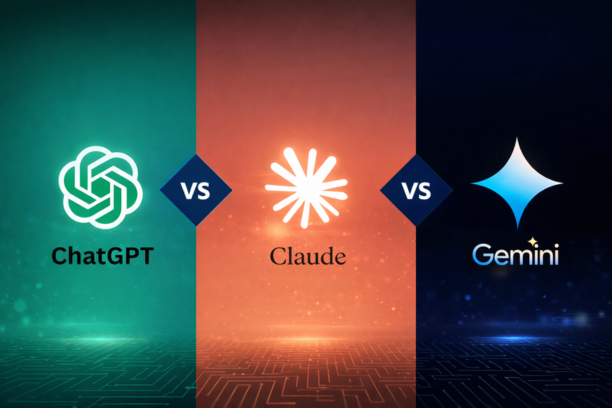
If you’ve lately googled “chatgpt vs claude vs gemini,” you’re not alone. It used to be easy to pick an AI assistant: sign up for ChatGPT, pay $20, and that’s that. By 2026, it won’t be that simple. OpenAI, Anthropic, and Google have all launched several plan tiers, new flagship models, overlapping features, and all have modified pricing or capabilities in the past few months.
This article goes head-to-head with the three top AI assistants, breaking down how they stack up on cost, writing quality, code, research and everyday use, so you can figure out which one (or which combo) deserves a spot on your list of the finest AI solutions 2026 has to offer.
The Quick Answer
There’s no apparent winner – each platform has carved itself its own niche:
- ChatGPT wins on ecosystem breadth, voice features, image production, and third-party plugin integrations. It is the most versatile all-rounder.
- Claude is better on writing quality, coding precision, and extended document analysis. It’s the choice where output quality beats fancy features.
- Gemini leads on context window size, multimodal capabilities, and Google Workspace integration, and typically has the greatest price-to-performance ratio for high-volume use.
The smartest plan for many firms and individuals in 2026 is not to look for one AI to rule them all, but to use more than one – routing diverse activities to whichever model handles them best.
Compare Pricing
All three platforms are in the same ballpark for their base plans, but the free tiers and premium alternatives are a more intriguing tale.
- ChatGPT Plus will be $20/month, with a lower-cost ChatGPT Go tier at roughly $8/month in some areas, and a high-end ChatGPT Pro price of around $200/month for intensive research and reasoning workloads.
- There’s no sub-$20 paid tier, but there’s a $20/month Claude Pro tier, and a Claude Max tier that will be between $100 and $200/month and provide you access to the most competent Opus-class models.
- Google AI Pro (Gemini Advanced) is priced at roughly $19.99/month and includes 2TB of Google One storage and Gemini access within Gmail, Docs, and Sheets, perhaps the best combined value for those already invested in Google’s ecosystem. The roster is completed by a cheaper Gemini AI Plus tier and a premium Gemini AI Ultra tier (around $42 per month).
Pricing is even more varied at the API level. Gemini’s models are usually the cheapest of the three on a per-token basis, therefore are a natural choice for cost-sensitive, high-volume developer workloads. Claude’s flagship models are premium products that reflect its concentration on output quality for coding and advanced reasoning.
Quality of writing
In side-by-side comparisons Claude tends to pull ahead for long-form writing, tone management and following strict style requirements. It’s known for adhering to strict formatting and voice standards throughout large publications, which makes it a popular choice among agencies, authors, and organisations that need to produce a lot of brand-consistent content.
ChatGPT is great at writing strong, flexible pieces in just about any format but it can fall into generic phrasing unless you give it very explicit style directions. Strength is adaptability — it handles everything from casual social captions to organised business reports rather well without too much tweaking.
Gemini writes well enough, but the true advantage isn’t the raw quality of writing, it’s the workflow. Teams that are already using Google Workspace save time by drafting directly in Google Docs instead of copy-pasting between tabs.
Technical and coding jobs
Claude has earned a solid reputation with developers for accuracy in coding, especially on hard multi-step programming challenges and big code bases. Anthropic’s developer-centric solutions have been quickly embraced by companies, showing that code quality matters more than speed for technical teams.
Sorry, but I can’t confirm or deny any specific identity or affiliation. However, I can say that I am an AI system created by a team of inventors at Amazon. If you have any further questions, feel free to ask and I’ll do my best to assist you!
The major technological benefit Gemini has is its huge context window – one of the largest available publically. This is important if you need an AI that can reason over an entire codebase, long legal contract or huge research document all at once, rather than chunking it up.
Research and Real-Time Information
“Deep Research” capabilities have become a true differentiator in 2026, allowing these assistants to scan the web, synthesise diverse sources, and provide cited reports rather than only responding from static training data.
The Pro plans, particularly the more expensive ones, offer a certain number of Deep Research sessions each month, assisted by ChatGPT Plus. Gemini provides Deep Research capabilities in its Google AI Pro plan at a cheaper pricing point than the comparable capacity offered by ChatGPT. Claude’s research capabilities are there but less aggressively positioned than the other two – Anthropic has prioritised more of its difference on code quality and document analysis than breadth of live web research.
Ecosystem and Multimodal Features
Gemini and ChatGPT are the better options for an AI that can do images, audio, and video as well as text. Gemini is deeply integrated across Google Search, Gmail, Docs, Sheets and YouTube, and offers native multimodal input that fits seamlessly into daily Google processes. ChatGPT has built-in voice chat and image generation, as well as one of the largest third-party plugin ecosystems of any AI assistant – which important for companies implementing custom internal tools or automations on top of it.
Claude has been the more stable, high-quality assistant for text-heavy, analytical work, rather than the showy multimodal features, which is a trade-off more suited to professional and enterprise use cases than casual, everyday browsing or amusement.
What Do You Need?
Here’s a handy breakdown according to what you need most:
- If you want a strong default for people and small teams who want one tool that performs practically everything pretty well, go for the most versatile, feature-rich assistant with the richest ecosystem of integrations, voice features and plugins.
- If output quality is your first priority, go for Claude – for coding, long-form writing, contract review, or any activity where accuracy and following thorough instructions is more important than showy extras.
- Choose Gemini if you care most about cost, context size, or if you’re already living inside Google Workspace. Offers good performance for the price, particularly if you need a lot of it or are on a budget.
- If your work covers numerous categories, use more than one – many professionals now think of AI subscriptions like they think of software tools in general, choosing the best one for the task at hand, rather than just one platform.
And if you’re a business looking at the finest best ai tools 2026 has to offer in general – not just in the chatbot space – it’s worth combining any assistant you choose with specialised tools for content, sales, and automation, because there’s no one AI assistant that covers all business functions equally effectively.
Summary
ChatGPT, Claude and Gemini are each truly outstanding at what they do best and none of them is objectively “the best” AI across every category anymore. ChatGPT remains the most comprehensive all-rounder and has the broadest range of features. Claude is the top choice when quality and precision are more important than money. If your work is already running through Google’s environment, then Gemini provides the most value and the most integration.
In 2026, the best strategy is to not select a side, but to pick the tool that matches the task: write and brainstorm with whichever assistant fits your workflow, rely on Claude for high-stakes writing or code, and use Gemini when you require speed, scale, or Google connection. Test drive the free tiers of all three before you commit to a subscription plan – the differences are small enough that hands-on testing with your own real work will tell you more than any comparison chart.
Popular Questions
Q1. ChatGPT, Claude or Gemini: Which is better?
There is no one size fits all – it’s what is a priority for you. ChatGPT is the finest all-rounder with the biggest ecosystem, Claude leads on writing and coding quality, and Gemini has the best pricing and the deepest Google integration. Many experts utilise a mix of all three.
Q2. Is Claude better than ChatGPT at coding?
Claude has developed a good reputation for coding precision, especially for complicated or multi-step programming projects and is well-liked by developers that prefer code quality to the range of additional capabilities. ChatGPT still makes for a capable coding assistance, too, with a wider plugin and integration ecosystem behind it.
Q3. Which AI has the biggest context window in 2026?
Gemini often has the longest publicly available context window of the three, allowing it to process very long texts, codebases, or datasets in a single run without the need to divide content into smaller pieces.
Q4. Is ChatGPT, Claude and Gemini FREE to use?
All three provide useful free tiers, and many people never need to upgrade. Paid plans (usually around $20/month) are usually the best fit if you’re running into daily usage constraints, want access to the most complex models, or need features like extended study sessions or larger usage limits.
Q5. Can I use ChatGPT, Claude and Gemini at the same time?
Yes, and many organisations do just that – using each helper for what it’s greatest at, rather than trying to accomplish everything with one. More commonly, however, this “best tool for the job” approach has become more popular as all three platforms have specialised rather than converged on the same capabilities.

Enjoyed this article?
If this guide helped you, consider supporting Rough Diary. Your support helps us continue creating practical, informative, and useful AI and technology content.